
Your book cover is the first impression of your book. A strong cover grabs attention and invites clicks. But how do you know which cover will sell more books? The answer is simple: Book Cover A/B Test Results reveal exactly what works and what doesn’t.
This case study breaks down Book Cover A/B Test Results to show what actually drives clicks, conversions, and book sales.
TL;DR
- Testing two book covers showed Cover B sold 4 times more books than Cover A. The winning cover had clear genre signals, readable text, professional design, and bold colors.
- Cover B got 2.3% click rate vs 0.8% for Cover A, and cost only $4.20 per sale vs $15.50.
- The lesson: test your covers with real ads before committing. Small design changes make huge sales differences.
What Is an A/B Test for Book Covers?
An A/B test means you show two different covers to real people. Then you track which one gets more clicks, sales, or downloads.
Think of it like this: You have Cover A and Cover B. You show each cover to 100 people. Cover A gets 15 clicks and Cover B gets 30 clicks. Cover B wins.
It’s that simple. No guessing. Just data.
Why Book Covers Matter More Than You Think
Here’s a hard truth: most people judge your book by its cover.
Multiple industry studies show readers take less than five seconds to decide if they’ll click on your book. If your cover doesn’t grab attention fast, they scroll past.
A good cover can double or even triple your sales. A bad cover can kill a great book.
Just like high-performing web pages, successful book covers rely on strong visual hierarchy to guide the viewer’s eye from title to imagery to author name in seconds.
To understand what makes a cover actually sell, you can also explore our detailed guide on book cover design that sells, where we break down genre signals, typography, color psychology, and more.
The Test Setup: How We Did It
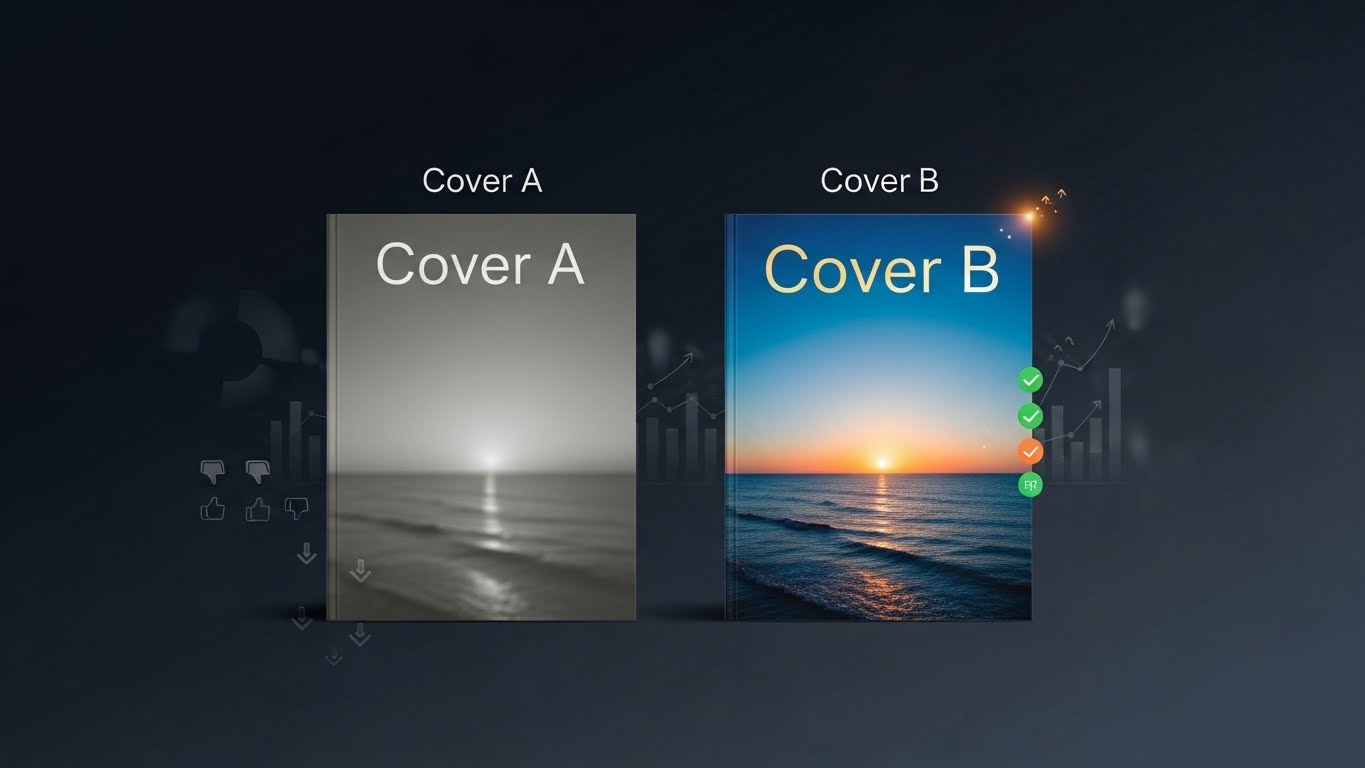
For this case study, we tested two covers for the same fiction novel. Here’s what we changed:
Cover A:
- Dark background
- Small text
- Generic photo
- No clear genre signals
Cover B:
- Bright, bold colors
- Large, clear title
- Professional design
- Clear romance genre signals
We ran ads to the same audience. Same book description. Same price. Only the cover changed.
The test ran for 30 days with a budget of $500 per cover.
The Results: Numbers Don’t Lie
Here’s what happened:
Click-Through Rate (CTR)
- Cover A: 0.8% CTR
- Cover B: 2.3% CTR
Cover B got almost 3 times more clicks. People were more interested when they saw it.
Conversion Rate
- Cover A: 2% conversion (people who bought after clicking)
- Cover B: 7% conversion
Cover B didn’t just get more clicks. It turned more clicks into actual sales.
Cost Per Sale
- Cover A: $15.50 per sale
- Cover B: $4.20 per sale
Cover B was cheaper to advertise because it worked better. You get more bang for your buck.
Total Sales in 30 Days
- Cover A: 32 books sold
- Cover B: 119 books sold
Cover B sold nearly 4 times more books with the same ad budget. These Book Cover A/B Test Results clearly show how small design changes can lead to massive differences in visibility and sales.
What Made Cover B Win?
Let’s break down why Cover B crushed Cover A.
1. Clear Genre Signals
- Cover B screamed “romance novel” from a mile away. Readers knew exactly what they were getting.
- Cover A looked like it could be any genre. Mystery? Thriller? Literary fiction? Readers couldn’t tell, so they kept scrolling.
- Lesson: Make your genre obvious. Romance readers want romance covers. Thriller readers want thriller covers.
2. Readable Title
- Cover B had a large, clear title. You could read it even in a tiny thumbnail on Amazon.
- Cover A’s title was too small. On mobile phones, it was almost impossible to read.
- Lesson: Test your cover at thumbnail size. If you can’t read the title, it won’t sell. A large, legible title isn’t just a cover design choice, it’s a core principle of readable typography, which directly affects whether readers stop scrolling or click through.
3. Professional Design
- Cover B looked like it came from a major publisher. It had polish and quality.
- Cover A looked homemade. The photo was stock and obvious. The fonts didn’t match.
- Lesson: Invest in a real designer. A $300 cover can make you thousands in sales.
4. Color Psychology
- Cover B used warm, inviting colors. Red and gold grabbed attention in a sea of blue and gray covers.
- Cover A used dark, moody colors that blended into the background.
- Lesson: Look at bestsellers in your genre. What colors do they use? Match that pattern.
Common Book Cover Mistakes to Avoid
Based on this test and others, here are mistakes that kill sales:
Using Too Many Fonts
Stick to 2 fonts maximum. More than that looks messy and unprofessional.
Cluttered Design
White space is your friend. Don’t cram every inch with text or images.
Wrong Genre Signals
A literary fiction cover won’t work for a romance novel. Match your genre’s expectations.
Poor Image Quality
Blurry or pixelated photos scream “amateur.” Always use high-resolution images.
Ignoring Mobile Viewers
Over 60% of book buyers shop on phones. If your cover doesn’t work on a small screen, you lose most potential buyers.
How to Run Your Own Book Cover Test
If there’s one thing these Book Cover A/B Test Results prove, it’s that even first-time authors can improve sales by testing covers before committing to a final design.
Want to test your covers? Here’s a simple way to start:
Step 1: Create Two Versions
Make one change at a time. Maybe test two different titles. Or two different color schemes. Don’t change everything. You won’t know what worked if you do.
If you want multiple design ideas quickly, platforms like 99designs book cover contests let you compare different creative directions at once.
Step 2: Use Amazon Ads
Set up two identical ad campaigns. Change only the cover image. Run each for at least 2 weeks with the same budget.
Step 3: Track Your Numbers
Watch these metrics:
- Click-through rate
- Conversion rate
- Cost per sale
- Total sales
Step 4: Pick the Winner
The cover with the best numbers wins. It’s that simple. Then create a new version and test again.
You can run book cover A/B tests using Amazon Kindle Direct Publishing (KDP) ads, where different cover images compete for clicks and sales.
Real Author Success Stories
Sarah M., Romance Author: “I changed my cover based on A/B testing. My sales went from 10 books a month to 150 books a month. Same book. Just a better cover.”
James T., Thriller Writer: “I thought my dark, artsy cover was perfect. Testing proved me wrong. A simpler, bolder cover tripled my sales.”
Final Thoughts: Test Before You Publish
Don’t guess what cover will work. Test it.
A few hundred dollars in testing can save you thousands in lost sales. The biggest takeaway from these Book Cover A/B Test Results is simple: testing beats guessing every time.
Remember: Your book might be amazing, but if the cover doesn’t grab attention, nobody will ever find out.
Quick Action Steps
Here’s what to do right now:
- Look at the top 20 bestsellers in your genre on Amazon
- Notice patterns in colors, fonts, and layouts
- Create 2-3 cover options that match these patterns
- Test them with real money on ads
- Use the winner
- Test again in 3-6 months
Book covers aren’t forever. What works today might not work next year. Keep testing. Keep improving.
Key Takeaways
These Book Cover A/B Test Results highlight how data-driven cover decisions outperform opinions, assumptions, and personal preferences.
- Book covers can make or break your sales readers decide in under 5 seconds
- A/B testing removes guesswork and shows you what actually works
- Clear genre signals are critical readers need to know what they’re buying
- Your title must be readable at thumbnail size (most people shop on phones)
- Professional design pays for itself a $300 cover can generate thousands in sales
- Color matters look at bestsellers in your genre and match their color patterns
- Test one change at a time so you know what made the difference
- Track click-through rate, conversion rate, and cost per sale
- Keep testing every 3-6 months as trends change
- Data beats opinions every time
Final Thoughts
This case study revealed a 4× jump in sales from a single cover change, and that’s massive. Your book deserves a cover that works just as hard as you did writing it. Don’t settle for “good enough.” Keep testing until you find what truly converts.
Numbers don’t lie. And in publishing, the data is clear: covers influence sales more than almost anything else. Make yours impossible to ignore.
Frequently Asked Questions
How much does it cost to cover A/B test book covers?
You can start with $100-200 per cover using Amazon Ads or Facebook Ads. Run each version for 2 weeks minimum. The total cost is around $200-400, but this investment can save you thousands in lost sales.
How long should I run an A/B test?
Run your test for at least 2 weeks, preferably 30 days. You need enough data to see clear patterns. If one cover is obviously winning after 2 weeks, you can stop early.
Can I test covers before my book launches?
Yes! Use sites like PickFu or run social media polls. Show both covers to your target readers and ask which they’d click. This gives you early data without spending on ads.
What’s the biggest mistake authors make with book covers?
Not matching their genre. A literary fiction cover won’t sell a romance novel. Study the top 20 bestsellers in your exact genre and follow their visual patterns.
Should I change my cover if my book isn’t selling?
Absolutely. If your book has good reviews but low sales, the cover is probably the problem. Test a new cover before you give up on the book.
Do I need to hire a professional designer?
For serious sales, yes. DIY covers usually look amateur. Professional designers cost $200-500 but they understand what sells. Think of it as a business investment, not an expense.